
Scorpio III: Pierce the False Flesh
By NM Thomen


Knowledge is not for knowing: knowledge is for cutting.
― Michel Foucault, Saturn in Scorpio III
In the third decan of Scorpio the two planets that are otherwise debilitated in this fixed water sign find dignity by face and triplicity: Venus and Moon. In the Chaldean order of the planets, Venus is this decan’s lord and the Moon rules Scorpio III by its traditional decanic triplicity. The nature of these nocturnal planets can tell us more about Scorpio III. Here, the Moon penetrates the reflection of the pool to touch the eutrophic depths; Venus pierces the fascia to strip off the false flesh.
Venus primarily represents desire and love, and we see how these significations are coloured through the sign of each decan she governs across the zodiac. In Aries III, the desires of Venus are burned up in the passions of the battlefield and require intensity to keep alight. In Cancer I, the desires of Venus become centered on mutually nurturing relationships through vulnerability. In Virgo II, the desires of Venus refine the ever-morphing task of embodiment necessary for the maintaining of prosperity. In Aquarius I, the desires of Venus become eccentric, motivating one’s independence at best and exacting one’s exclusion at worst. In Scorpio III, the desires of Venus go through a process of distortion, putrefaction and ultimately dissolution to reach their fulfillment.
There's a way that the force of disappointment can be alchemized into something that will paradoxically renew you.
—Martin Scorsese, Sun-Venus Cazimi in Scorpio III
The precursors to the transformation associated with Scorpio begin to actualize here in its final face where obsessive desire is fully addressed to be alchemized. Traditionally, this decan was correlated with depravity, degeneracy, corruption and vice. It is a place where one comes face to face with the fears and longings lurking within one’s watery depths.
In Three Books of Occult Philosophy, Agrippa describes the symbolic image of Scorpio III as “A man bowed downward upon his knees, and a woman striking him with a staff” signifying “drunkenness, fornication, wrath, violence and strife”. Al-Qurtubi in Ghayat al-Hakim specifies that this decan “indicates sinfulness, impudence and disdainful forced marital sex achieved by subduing and angering.” Austin Coppock expands on this in 36 Faces to say that when one fully possesses the root of their desire, one achieves liberation from it. Otherwise, desire has the power to control one through the fixed pursuit of extreme indulgence.
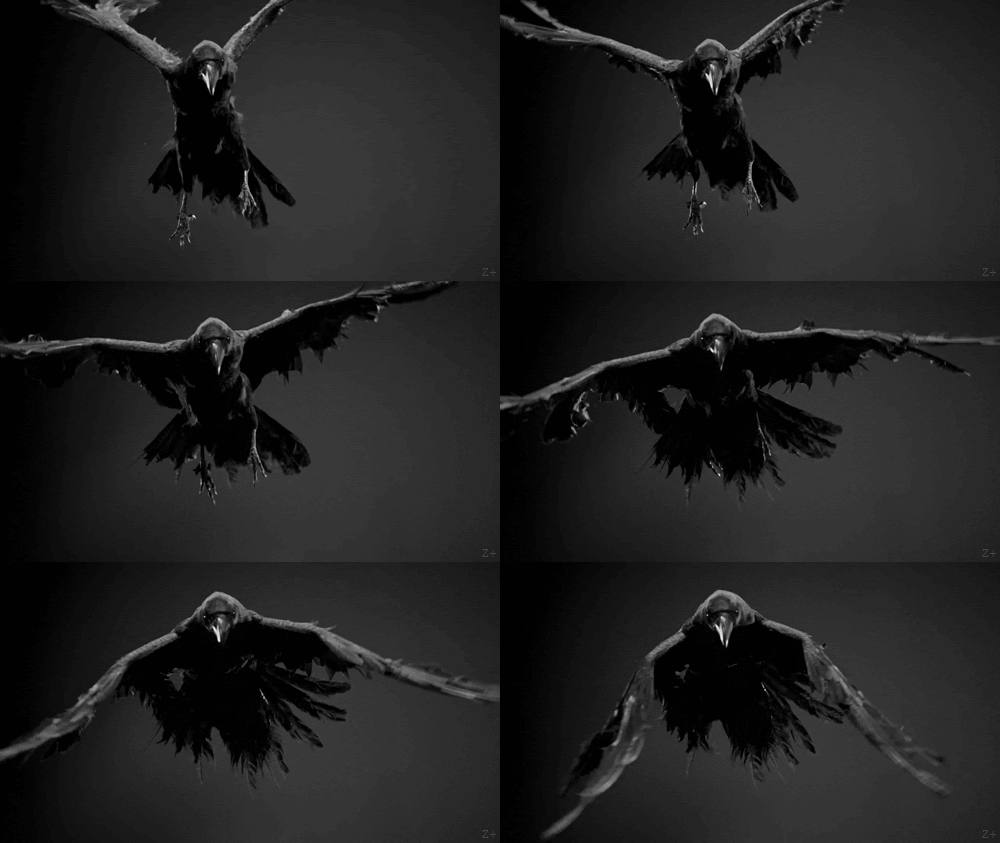
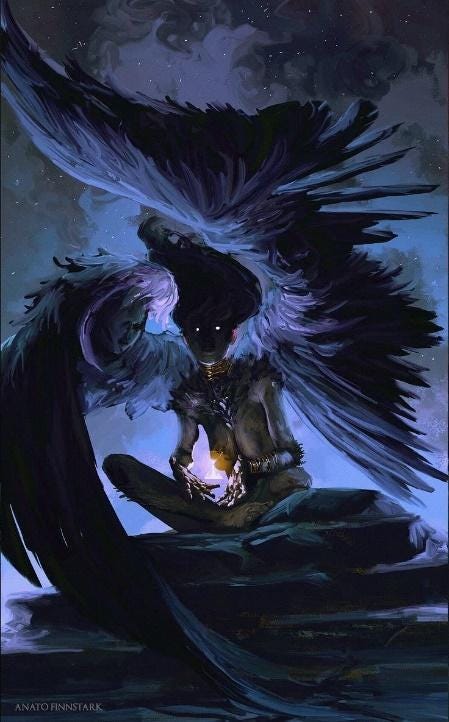
Scorpio III is where Venusian vice appears as fantasy, in variant forms of the false flesh, the mortal materiality that inevitably falls away. This face of Scorpio is the Black Crow, the corvus nigredo phase in alchemy where putrefaction occurs. Desire, lust, obsession, debauchery, corruption, depravity, violence and vice are pecked at by the Crow to be decomposed back into their prima materia. It is the archetypal encounter with the Jungian Shadow in the “Dark Night of the Soul”. The symbolic nekya by which our ghosts may be summoned to guide us.
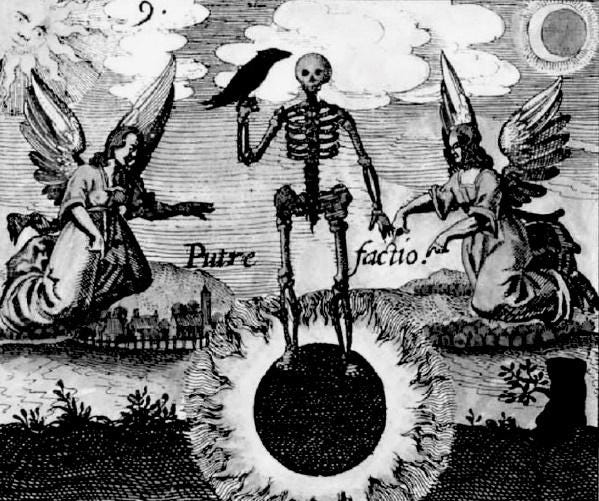
Putrefactio from Philosophia Reformata, 1622
The phenomenological approach of Scorpio III requires direct experience through self-inquiry to dig at the root of all desire that otherwise remains unconscious and perilous. It beseeches us to cultivate through inner awareness an outward understanding of human behavior, but not without loving compassion that Venus also generously grants. The potential here is the transmutation of moral and spiritual transgressions into pathways of redemption that convert vice into virtue, obsession into devotion.
I never really understood the word ‘loneliness’. As far as I was concerned, I was in an orgy with the sky and the ocean, and with nature.
—Björk, Sun in Scorpio III
People think I'm disciplined. It is not discipline. It is devotion. There is a great difference.
—Luciano Pavarotti, Jupiter in Scorpio III
Tarot of Scorpio III
I saw my life branching out before me like the green fig tree in the story. From the tip of every branch, like a fat purple fig, a wonderful future beckoned and winked. One fig was a husband and a happy home and children, and another fig was a famous poet and another fig was a brilliant professor, and another fig was Ee Gee, the amazing editor, and another fig was Europe and Africa and South America, and another fig was Constantin and Socrates and Attila and a pack of other lovers with queer names and offbeat professions, and another fig was an Olympic lady crew champion, and beyond and above these figs were many more figs I couldn't quite make out. I saw myself sitting in the crotch of this fig tree, starving to death, just because I couldn't make up my mind which of the figs I would choose. I wanted each and every one of them, but choosing one meant losing all the rest, and, as I sat there, unable to decide, the figs began to wrinkle and go black, and, one by one, they plopped to the ground at my feet.
—Sylvia Plath, Mercury in Scorpio III
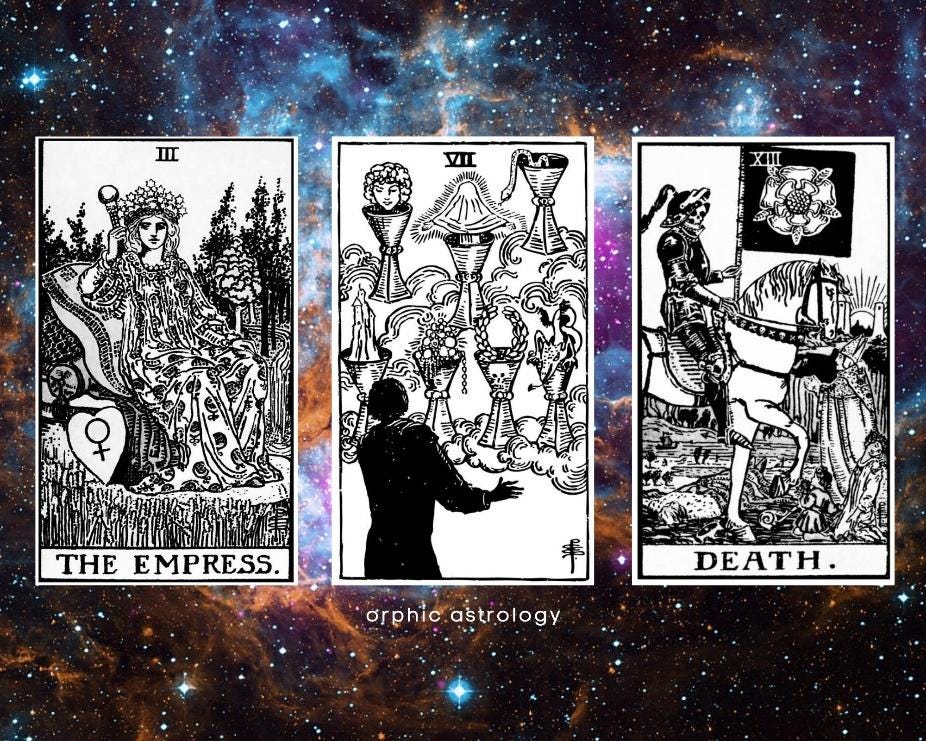
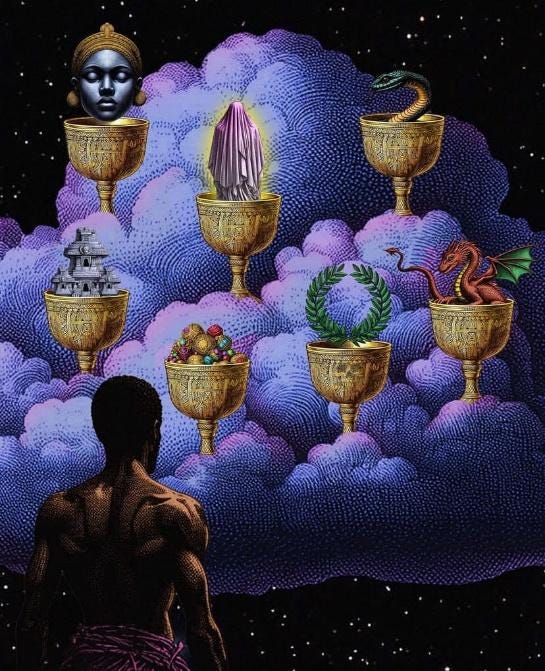
The third decan of Scorpio corresponds to the Seven of Cups minor arcana, the Lord of Debauch. The decan’s ruler Venus corresponds to The Empress and Death corresponds to the sign of Scorpio in the major arcana.
When the Seven of Cups appears, it asks you to take action on bringing forth your wishes and desires to fulfill them instead of guarding them as fantastical daydreams. Christopher Marmolejo, author of Red Tarot: A Decolonial Guide to Divinatory Literacy, reiterates Venus’ power in this card: “Mesmerized by the objects of desire, she must realize herself the snake-charmer before the cobra consumes her whole.” The Seven of Cups reflects back to us our overwhelm with our longing and it reminds us that we have the choice to overcome or be overcome by our hungers.
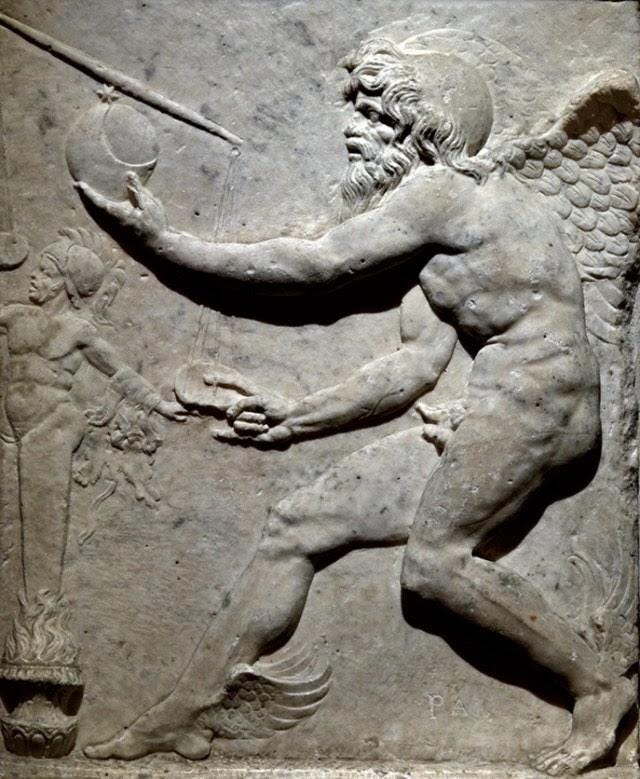
The 36 Airs of the Zodiac classifies Kairos (Caerus) —the youngest son of Zeus and lover of Tyche— as the deity abiding in Scorpio III. Kairos is described as the divinity of opportunity, luck, favorable moments and advantageous occasions. The right place at the right time. Its Roman equivalent is Occasio or Tempus.
The better you feel about yourself, the less you feel the need to show off.
—Robert Hand, Mars in Scorpio III
Bound Lords of Scorpio III: Jupiter & Saturn
The remaining 10 degrees of Scorpio are also subdivided into two terms which are ruled by Jupiter and Saturn.
Valens describes the bound of Jupiter (19°—24° Scorpio) as “talented, lucky, high-priestly, glorified in gold, purple, and the high offices appropriate to the inherent greatness of the nativity. This term is beneficient and as a whole loves men and gods.”
The remaining 6° of Scorpio comprise the bound of Saturn: “punitive, with few children or brothers, haters of their own relatives, poisoners, melancholic, and misogynists, having secret wounds, and in general very punitive and cursing fate. They are hated by both gods and men; they resist their superiors and are despised by their inferiors.”
Although the characteristic of noise is that of reminding us brutally of life, the Art of Noises should not limit itself to an imitative reproduction. It will achieve its greatest emotional power in acoustical enjoyment itself, which the inspiration of the artist will know how to draw from the combining of noises.
― Luigi Russolo, Moon in Scorpio III, Bound of Saturn
Fixed Stars of Tropical Scorpio III
And in the third facie there arise the preceding parts of the Stallion, i.e. Centaurus, a big image carrying a Hare [Lepus], which is biting him. And the preceding parts of the Bull and the Dog. And the holder of reins [Ophiuchus], keeping snakes in his hands.
Indians say that a dog and a jackal arise in this facie. And a wild boar and a panther, and its hairs are turned white. And different wild animals, living in a sandalwood forest and watching and fearing each other another.
According to Ptolemy, in this facie there arises the chest of Ursa Minor, the coil in the body of Draco, the foot of the Kneeling Man [Hercules] - and his right shoulder and arm, and the right arm of Serpentarius. The belly of Scorpio and the knots in its tail. And the fire in the upper part of the Ara.
—Abu Ma’shar

Unukalhai (Alpha Serpentis) — The Heart of the Serpent, Unukalhai marks the heart of the Serpens constellation held by Ophiuchus. It is found at the projected zodiacal longitude of 22°24’ tropical Scorpio (28°13’ sidereal Libra).
Agena aka Hadar (Beta Centauri) — Hadar is the official name of Beta Centauri though traditionally it was also known as Agena. It marks the left knee of the Centaur found at the projected zodiacal longitude of 24°07’ tropical Scorpio (29°56’ sidereal Libra). Beta Centauri is one of two “Pointers” used to locate the Southern Cross.
Rigil Kentaurus aka Bungula (Alpha Centauri) — Rigil Kentaurus is the Latinisation of the Arabic Rijil al-Quinturus, “the Foot of the Centaur”. As the principal star in the asterism marking the was also known as Toliman, the Latinisation of the Arabic al-Zulman, “the ostriches”, after the name of the lunar manzil. 29°46’ tropical Scorpio (05°35’ sidereal Scorpio)
Fixed Stars of Sidereal Scorpio III
Rasalgethi (Alpha Herculis) 22°18’ sidereal Scorpio (16°30’ tropical Sagittarius )
Sabik (Eta Ophiuchi) 24°07’ sidereal Scorpio (18°17’ tropical Sagittarius)
Rasalhague (Alpha Ophiuchi) 28°35’ sidereal Scorpio (22°46’ tropical Sagittarius)
Stars in the tail of the Scorpius constellation which have precessed into the sidereal first decan of Sagittarius:
Lesath (Upsilon Scorpii) 00°09’ sidereal Sagittarius (24°20’ tropical Sagittarius)
Shaula (Lambda Scorpii) 00°43’ sidereal Sagittarius (24°55’ tropical Sagittarius)
Aculeus (M6 Scorpius) 01°56’ sidereal Sagittarius (26°07’ tropical Sagittarius)
Acumen (M7 Scorpius) 04°51’ sidereal Sagittarius (29°02’ tropical Sagittarius)
Plant Medicine of Scorpio
Hermes Trismegistus “On the Plants of the Twelve Zodiac Signs”
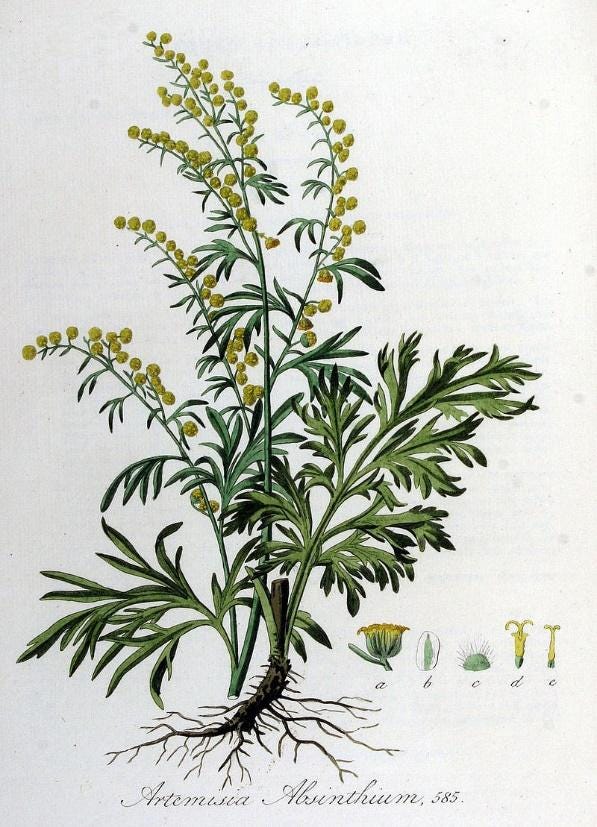
Scorpio: αρτεμισια — Artemisia (Artemisia absinthium) aka Common Wormwood [Dsc. 3.113.]
For these herbs must be gathered and made into a juice when the Sun is in Aries. But it is also necessary for each herb to be collected when the Moon is in a trine aspect to the Sun or in its horoscope, each according to the zodiac sign it belongs to and the Moon’s position. And let the day and hour be of the ruler of the zodiac sign, so that you may prosper, as the teacher says, “according to the cosmic and natural outcome.”
[From Catalogus codicum astrologorum graecorum, vol.7, translated by Chris Lyon]
References
Agrippa, Henry Cornelius. Three Books of Occult Philosophy. Llewellyn Publications, 2009.
Chang, T. Susan. 36 Secrets: A Decanic Journey through the Minor Arcana of the Tarot. Anima Mundi Press, 2021.
Coppock, Austin. 36 Faces: The History, Astrology and Magic of the Decans. Three Hands Press, 2014.
Foucault, Michel. Madness and Civilization: A History of Insanity in the Age of Reason. Librairie Plon, 1964.
Catalogus codicum astrologorum graecorum. Translated by Chris Lyon.
Marmolejo, Christopher. Red Tarot: A Decolonial Guide to Divinatory Literacy. North Atlantic Books, 2024.
Ma’shar al-Balkhi, Abu. The Decans of Albumasar, Abu Ma’shar al Balkhi. Translated by Margherita Fiorello. 2009.
Plath, Sylvia. The Bell Jar. Faber and Faber, 1971.
Russolo, Luigi. The Art of Noise. 1913.
Valens, Vettius. The Anthology. Translated by Mark T. Riley. Amor Fati, 2022.
About the Author

NM Thomen (they/themme/she) is an astromancer and sky-watcher, diviner, spirit-worker and body-worker, writer, independent researcher and multi-hyphenate creative based in Ouidah, Bénin where they serve as the official astrologer for the Supreme Chief of Vodoun, Dada Daagbo Hounon Houna II. Their work centers at the intersecting roots of various mystical traditions and ancestral cosmologies. To learn more, visit:
Website: OrphicAstrology.com
Substack: orphicastrology.substack.com
 | A guest post by
|